Table of Contents
TogglePeonies are the rockstars of spring gardens, massive, fragrant blooms that return year after year with minimal fuss. If you’re thinking about refreshing your front yard landscaping, these herbaceous powerhouses belong near the top of your plant list. They’re not just pretty faces: they’re also tough plants that can outlive the people who plant them, sometimes thriving for 50+ years or more. Whether you’ve got a sprawling lawn or a modest front garden, peonies work as focal points, border plants, or scattered throughout a mixed bed. This guide walks you through variety selection, soil prep, planting, and design tips to create a front entrance that makes your neighbors stop mid-jog to ask questions.
Key Takeaways
- Front yard peony landscaping transforms curb appeal with massive, fragrant blooms that return year after year and can thrive for 50+ years with minimal maintenance.
- Choose herbaceous peony varieties suited to your USDA hardiness zone—hardy cultivars like ‘Karl Rosenfield’ for cold climates and heat-tolerant Japanese types for zones 8–9.
- Plant peonies in full sun (6+ hours daily) with well-draining soil, positioning the crown just 1–2 inches below ground level and spacing plants 3–4 feet apart to prevent rot and fungal issues.
- Once established by year three, peonies need water only during droughts and minimal fertilizer, making them an ideal low-maintenance solution for homeowners seeking budget-friendly landscaping.
- Design impact peaks when peonies anchor your front entrance as focal points or mixed plantings paired with complementary bloomers like tulips, salvias, and ornamental grasses for extended seasonal color.
Why Peonies Are Perfect for Front Yard Landscaping
Peonies tick every box for front yard ambition. They’re long-lived perennials that require zero pest sprays and shrug off diseases that demolish other plants. Once established (usually by year three), they need water only during droughts, making them ideal for homeowners who don’t want to fuss with daily irrigation or expensive upkeep.
Their visual impact is undeniable. A mature peony can produce dozens of dinner-plate blooms, 6 to 10 inches across, in a single season. Colors range from pure white to blush pink, deep crimson, and coral. Some varieties are semi-double or fully double, with petals so layered they look like roses. Fragrance varies too: many varieties smell like roses crossed with honey.
Another huge advantage: peonies attract pollinators and look good in mixed plantings or as standalone specimens. They work equally well in traditional, cottage, modern, or Asian-inspired landscapes. If you’re planning landscaping ideas for front yards, peonies give you instant garden credibility.
Choosing the Right Peony Varieties for Your Climate
Peonies fall into three main types: herbaceous, woody shrubs (tree peonies), and Itoh hybrids. Most front yard landscapes use herbaceous peonies, which die back to the ground each winter in zones 2–8 and resprout in spring. Tree peonies are woody-stemmed shrubs best suited to zones 4–8: they hold their structure year-round but cost more and mature slowly.
For cold climates (zones 3–5), go with hardy cultivars like ‘Karl Rosenfield’ (deep red, early), ‘Festiva Maxima’ (white with red flecks, mid-season), or ‘Sarah Bernhardt’ (rose-pink, mid-to-late). These have proven track records through harsh winters.
Warmth-tolerant zones (6–8) have broader options. ‘Coral Charm’ (coral-orange, single), ‘Buckeye Belle’ (deep red, semi-double), and ‘Elsa Sass’ (white, mid-late) perform reliably. In zones 8–9, select heat-tolerant Japanese or Chinese types bred for southern gardens, though some benefit from afternoon shade in peak summer.
Check your USDA hardiness zone and local extension office for region-specific recommendations. Buying from a reputable nursery that ships bare-root peonies in fall (September–November) often gives you healthier plants at better prices. Plan your design thoughtfully, whether you’re tackling small front yard landscaping ideas or a spacious entrance.
Planting and Site Preparation Essentials
Preparing Your Soil and Location
Peonies need full sun (6+ hours daily) and well-draining soil. Waterlogged roots rot within weeks: this is the number-one killer of new plantings. If your front yard has clay or poor drainage, amend the planting area with 3–4 inches of compost and peat moss, tilled 12 inches deep.
Peonies are not heavy feeders. Overly rich, nitrogen-heavy soil produces leafy plants with fewer blooms. Test your soil pH: peonies prefer slightly alkaline to neutral (6.5–7.5 pH). If your soil is very acidic, add lime according to soil test results.
Select a location away from tree root competition and afternoon heat stress. A spot with morning sun and dappled afternoon shade works well in zones 7–9. Avoid planting directly against your house foundation, roots can interfere with concrete, and the microclimate is often too hot and dry.
Planting Steps and Spacing
- Dig a hole 12 inches deep and 18 inches wide. Mound the soil in the center to create a cone.
- Position the root (called a crown or division) so the “eyes” (dormant buds) sit just 1–2 inches below soil level. This is critical, plant too deep and blooms won’t appear for years: too shallow and the crown dries out.
- Backfill with amended soil, pressing gently to eliminate air pockets. Don’t compress hard: roots need oxygen.
- Water thoroughly to settle the soil, then apply 1–2 inches of mulch around the plant (not touching the stem). Avoid pine needles or acidic mulches: use shredded bark or composted leaves.
- Space plants 3–4 feet apart to allow mature width and airflow, which reduces fungal issues.
Fall planting (September through October in northern zones) gives roots time to establish before winter dormancy. Spring planting works in cold zones but delays first-year establishment. If your site slopes or has poor drainage, consider raised beds or berms to keep crowns high and dry.
Care and Maintenance Throughout the Growing Season
Once established, peonies are low-maintenance, but the first two years require consistent watering. Water deeply 1–2 times per week if rainfall is sparse: taper off in fall so the plant hardens for winter. Never overhead-spray at night, wet foliage invites powdery mildew and botrytis (a gray mold).
In early spring, as shoots emerge, apply a balanced fertilizer (like a slow-release 10-10-10) around the base. Skip the heavy stuff: peonies don’t need much. One light feeding per season is plenty. If you’re tackling landscaping on a budget, skip commercial fertilizer and work in 1 inch of compost yearly, it feeds slowly and improves drainage.
Deadhead spent blooms to keep plants tidy, but leave the foliage until frost kills it. That green growth feeds the roots for next year’s flowers. Cut everything to the ground in late fall or early spring (before new shoots appear). Clean up all debris to reduce disease carryover.
Stake tall varieties (over 3 feet) early in the season using a peony ring or three sturdy stakes with twine. This prevents stems from flopping after heavy rain or when blooms weigh them down.
Pests are rare, but ants often appear on buds. They’re harmless: they’re actually feeding on nectar, not harming the plant. If powdery mildew develops, prune out affected leaves and improve air circulation. Fungal rot is the main concern, it appears as blackened stems. Remove infected growth immediately and ensure excellent drainage.
Design Ideas for Peony Front Yard Landscapes
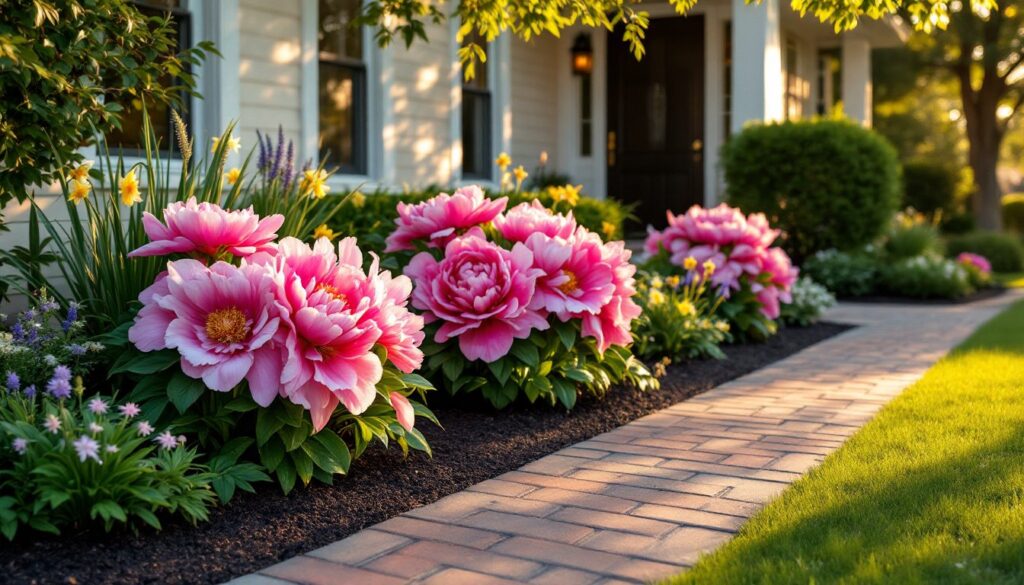
Peonies shine as focal points near your front entrance. Plant a single peony or a trio of the same variety at the corner of a pathway or beside your front door. When they bloom, they’re the first thing visitors see, instant curb appeal.
Mix peonies with complementary bloomers for extended color. Early spring bulbs (tulips, daffodils) fill the gap before peonies flower. Follow with salvia, catmint, or Russian sage for early-summer texture and color continuity. Late bloomers like coneflowers and ornamental grasses bridge the gap into fall. This succession keeps your front yard interesting May through October.
For compact spaces, consider small front yard landscaping ideas that pair a single dwarf peony (3–4 feet tall) with ornamental foliage plants, hostas, heuchera, or Japanese forest grass, to create depth without overwhelming the space.
Design magazines and resources like Gardenista showcase peony-focused front yard layouts that balance structure with softness. Create layers using background shrubs (lilac, viburnum), mid-layer peonies, and foreground grasses or perennials. This gives your landscape depth and prevents a flat, boring appearance.
Don’t overcrowd. Peonies are architectural plants that deserve breathing room. Space them at least 3–4 feet apart and leave gaps for spring bulbs and filler plants. Mulch paths between plantings with crushed stone or shredded bark to define zones and reduce maintenance.
For a cottage-style front, use mixed colors and pair peonies with roses, delphiniums, and self-seeding annuals. Traditional layouts favor symmetry: identical peonies flanking a door or path. Modern landscapes use bold single-variety blocks or staggered groupings for visual impact. Whatever your style, let peonies anchor the design, they’re strong enough to carry the show.